
Search
The Life Course Centre is a national centre funded by the Australian Research Council Centre of Excellence Scheme and hosted through the University of Queensland with collaborating nodes at the University of Western Australia, Sydney University and University of Melbourne.
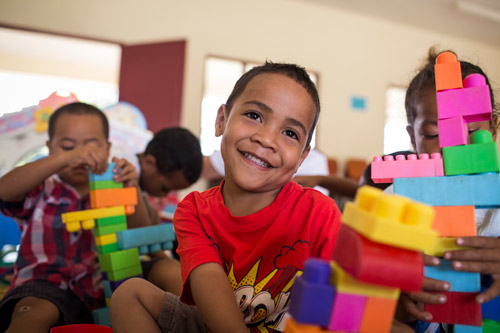
In Australia, community playgroups are seen as the ‘soft touch’. But a research project in Tonga is finding the benefits can last a lifetime.

New research by The Kids Research Institute Australia has found children who attend playgroups achieve better early primary school outcomes.
This study investigated where preschool children were more or less active in outdoor play areas in Early Childhood Education and Care (ECEC) centers using a novel method of combined device-measured physical activity, spatial data and on-site audit data.
Daily physical activity is critical during the early years of life for facilitating children's health and development. A large proportion of preschool children do not achieve the recommended 3 h of daily physical activity. Early childhood education and care (ECEC) services are a key setting to intervene to increase physical activity. There is a significant need for ECEC specific physical activity policy, including clearer guidelines on the amount of physical activity children should do during care, and strategies for implementation of these guidelines.
The environmental influences on early childhood development are understudied. The association between vegetation cover (i.e., trees, shrubs, grassed areas) in four key behaviour settings and socioemotional functioning was investigated in 1196 young children (2–5 years).
A significant number of children attend Early Childhood Education and Care (ECEC). ECEC is an important environment and behaviour setting for young children. Time spent outdoors is positively associated with children's physical activity levels, yet increased time spent physically active outdoors may expose young children to traffic-related air pollution, particularly in ECEC centres located in high traffic areas.
Playgroups are widely used throughout the Australian community yet understanding of their efficacy is hindered by inconsistent playgroup definitions and practice principles. This study aimed to develop, implement and evaluate the feasibility of a manualised therapeutic playgroup for children with developmental delay and their families using a three step process.
This review examines evidence of the association between the neighborhood built environment, green spaces and outdoor home area, and early (0-7 years) child...
The Early Years Systems Evidence (EYSE) team specialises in working in partnership with governments and service providers, with a distinct focus on improving the life chances of children in Australia.